
When I started the project Devyah, last summer, I was wondering what would be a perspective on femininity devoid of patriarchal influence. During this research, I figured my only choice to find out such a perspective were the matriarchal societies in Africa becore Europran colonialism destroyed them, which left me a bit stuck as those societies were in places now ravaged by wars sustained by the same colonialist powers whichdestryed them in the first place. Also, the destruction was so swift and brutal that it left very little behind, and by nature a matriarhal society isn’t focused on leaving traces for posterity but living in harmony here and now. Sounds lime yoga, right? I will get back to that a bit later.
To my amazment, I did manage to find such a perspective from a source I wouldn’t have considered would it not have revealed itself to me: archeology. More specifically, the perspective of Lithuanian archeologist Marija Gimbutas on pre-historycal, especially Neolithical cultures. She proposes a different perspective than most of her male collegues, which reveals the importance of femininity (feminine energy) to those societies, which were matriarchal and matrilineal and had a community/ partnership structure as opposed to the herarchical one of later indo-european which brought patriarchy and war to Europe and deemed it more civilizade than the peaceful ones they found there. As testimony to this claim, are the setllements with very little to no fortification and absolutely no depiction of warfare though the architectural development, arts and tool manufacturing were masterful beyond what we are led to belive by our mainstream education.
Marija Gimbutas wrote in 1991, in “The civilization of the Goddess” exactly what I feel now:
We must refocus our collective memory. The necessity for this has never been greater as we discover that the path of “progress” is extinguishing the very conditions for life on earth.
The book, I will cite further, unless stated otherwise, is “The language of the Goddess“, written two years earlier.
In the preface of this book, James Campbell says:
The message here is of an actual age of harmony and peace in accord with the creative energies of nature which for a spell of some four thousand prehistoric years anteceded the five thousand* of what James Joyce has termed the “nightmare” (of contending tribal and national interests) from which it is now certainly time for this planet to wake.
In the intro of the book, Marija states:
We are still living under the sway of that aggressive male invasion and only beginning to discover our long alienation from our authentic European Heritage — gylanic [communal, non herarchical], nonviolent, earth-centered.
She continues to interpret the symbols which decorate objects dated from Neolithic Era and before. Here, my logical, analythical mind kicked in and started questioning her interpretations as everything was centered around femininity without any clear proof. I question the art critics interpreting dead artists’ works from two dacates ago, let alone art created 8000 years ago. It seemed everything was a depiction of water and streams, which even today are asociated with feminine energy, so that has a standing ground. Howevere, both stratight lines or swirls are water to Gimbutas. A checkboard is a stream? Everything was a depiction of the Goddesess? We have decoration just for the sake of it. Surely they had that too. Also, we have depictions of regular people which don’t represent God(esse)s. Same in prehistory, right?
But then I realized that men archeologists also pulled out of their ass the explenations of what they found from those excavations to suit their biased views. We know now that women were hunting alongside men. Moreso, women’s bodies are more suited for hunting then male bodies. Not only do we have proof from other species where the female is the huntress, while the male rarely does anything but posture and contribute to reproduction (ex. the lioness), but in early indo-european culture there was Goddess of war (which I suspect is a wrong intepretation, but she was rather a Goddess of Hunting) and not a God. I will get back to this in another post.
So, if I have to support an interpretation, I’d rather support one which is not coming from people backing an oppresive system and parroting the same rethoric of peoples who portayed the oppresed as savages to give legitimacy to their abbusses and crimes, when in fact those societies were above them if only by being in harmony and living peacefully, though archological excavations show a development beyong the indo-european peoples, which took them almost 3000 years to surpass in Europe.
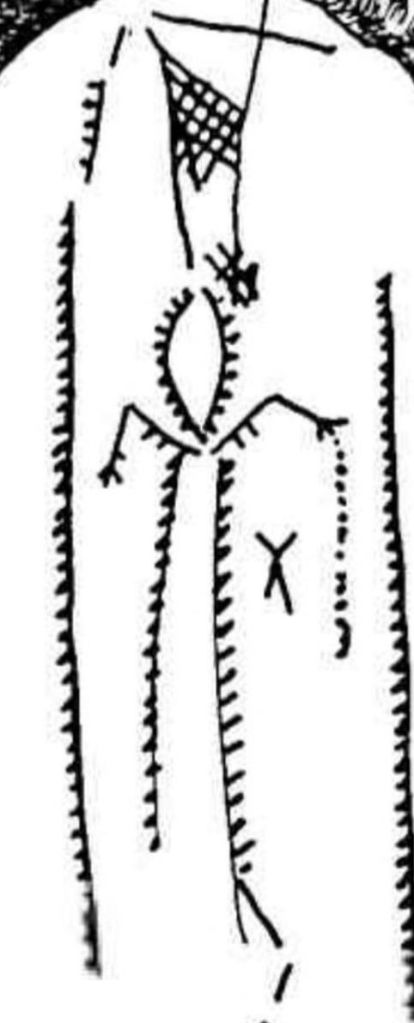
One of the symbols she points to are three lines repeated on way too many artefacts from different areas to be made by chance:
The tri-line sign seems to symbolize a triple (or multiple) life substance of dynamic quality which flows from the body of the Bird Goddess, the Giver and Sustainer of Life.
There are also three channels of energy in the body acording to Hinduism, which is the oldest religion recognized by current patriarchal views, dating from only 5000 years ago*, whereas those artefacts are over 8000 years old.
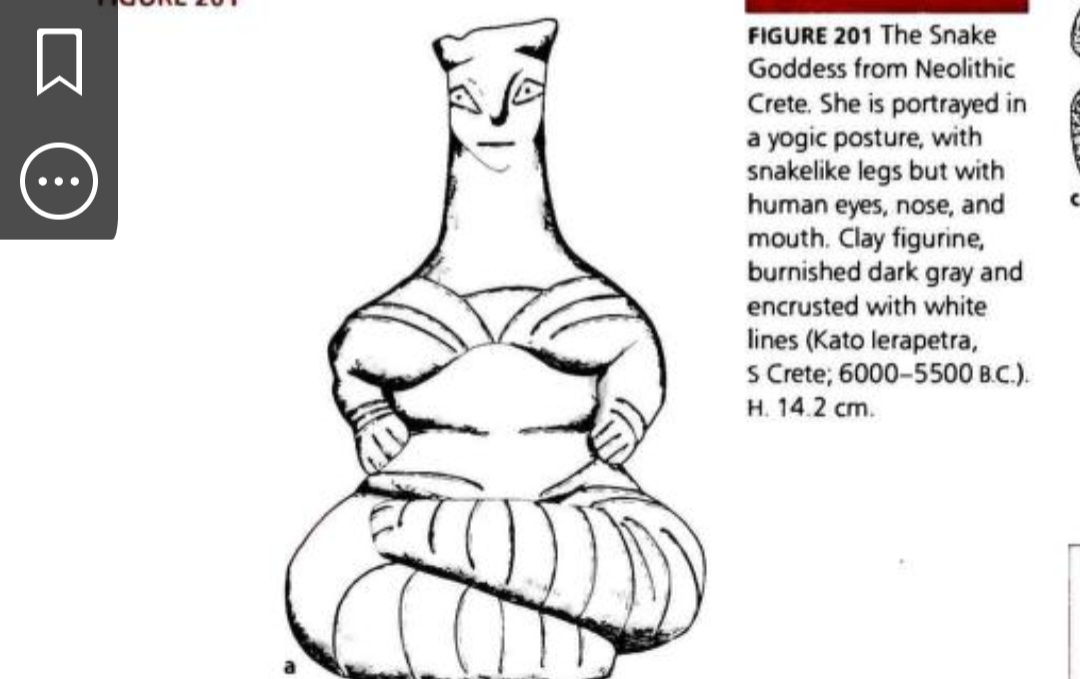
The three line thing may not be proof of anything, I can understand, so here are some statuets of women in lotus pose from 6000-5500 BCE:
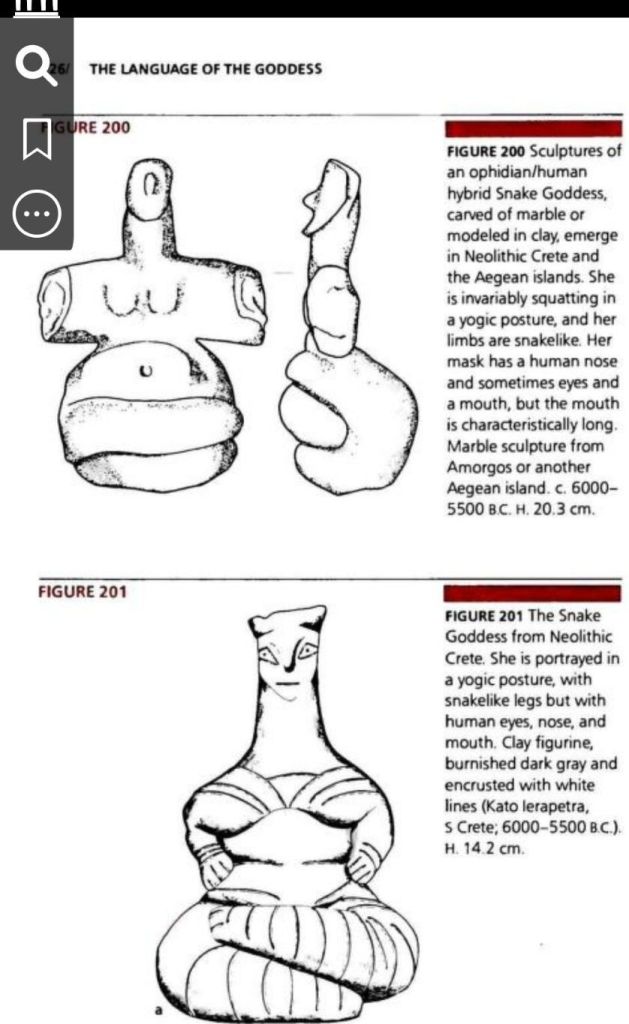
There are no other asanas depicted, and I have a theory for that I will not develop here.
Another connection with the culture from Bharata (Indian) culture is the lingam, though some 2000-3000 years older:
The Old European phallus is far from being the obscene symbol of our days. Rather, it is close to what is still found in India, the lingam, a sacred cosmic pillar inherited from the Neolithic Indus valley civilization.
Since the snake is mentioned in the notes on the picture above, I have to underline that the snake was preasied by prehistoric civilization, proof of which is in the influence on the Greek culture, where in antiquity the snake was a symbol of healing, which is also found in pre-Christian slavic culture.
From the quote below, we can observe how Christianity took all symbols which preceded it and turned them on their heads, making the good, bad, although it is not quite correct to state that, because I see no evidence that prehistoric peoples had the notions of good and bad or of most dychotomies we live by.
The snake was a symbol of life energy and regeneration, a most benevolent, not an evil, creature. Even the colors had a different meaning than in the Indo-European symbolic system. Black did not mean death or the underworld; it was the color of fertility, the color of damp caves and rich soil, of the womb of the Goddess where life begins. White, on the other hand, was the color of death, of bones—
There were definitely the notions of day/night but not necessarily as opposited but rather of a continuum. There were also the notions of life and death, but death was rather a passage than an ending, so again, not an opposite of life.
The Death Wielder does not punish men for, evil doing or anything of the kind; she only fulfills her necessary duty. The regeneration starts at the moment of death. It begins within the body of the Goddess, in her moist uterus which is expressed in an animal form as a fish, frog, turtle, hedgehog, hare, or the head of the bull.
Similarly, I don’t think they opposed feminine and masculine, but saw them rather as complements, which they actually are.
I have seen in this book way too many statuets which combine the feminine and masculine organs to not be sure they understood exactly how life was created. The prevelance of vulva over penis depictons must be due to the fact that this pathway was more obvious and directly connected to creating and maintaining life. The seeds are important for sure, but the environment is crucial for life to evolve and thrive. Those symbols were not sexual, but methaphors for all life. Especially for Neolithic civilization which already had agriculture and domesticated animals. They has rituals before and after seeding.
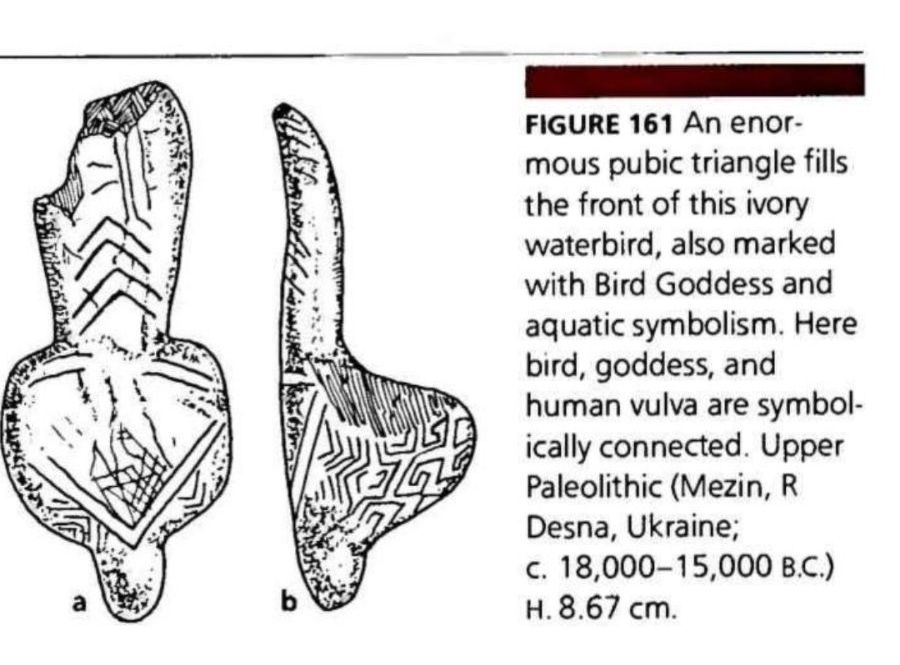
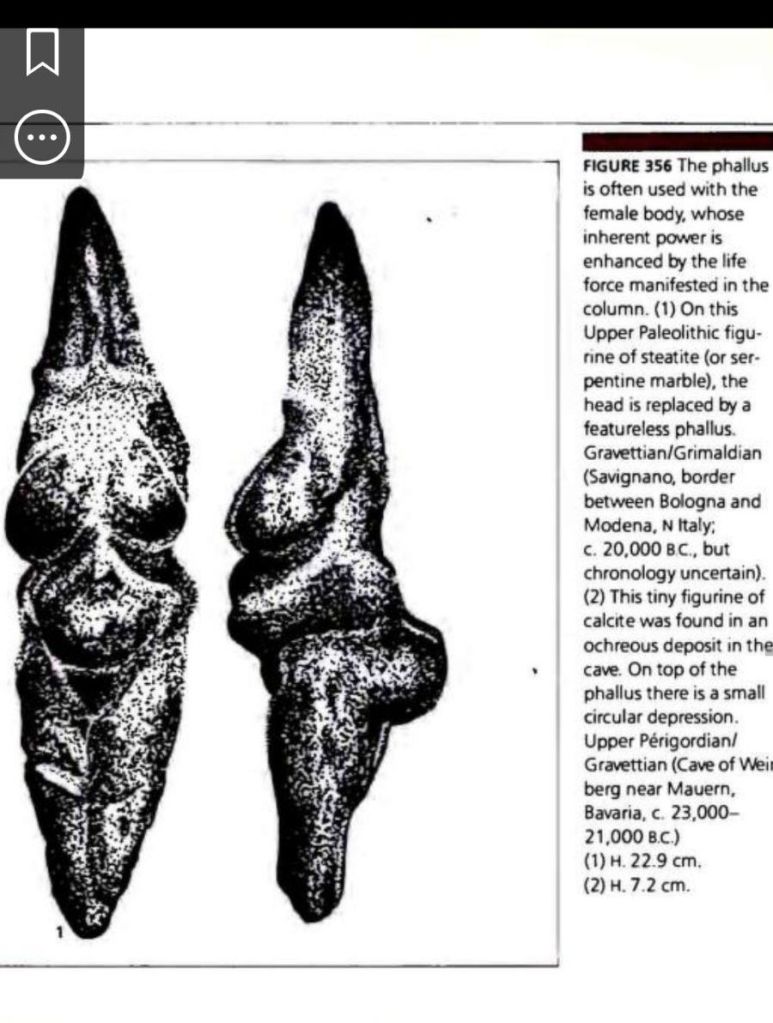
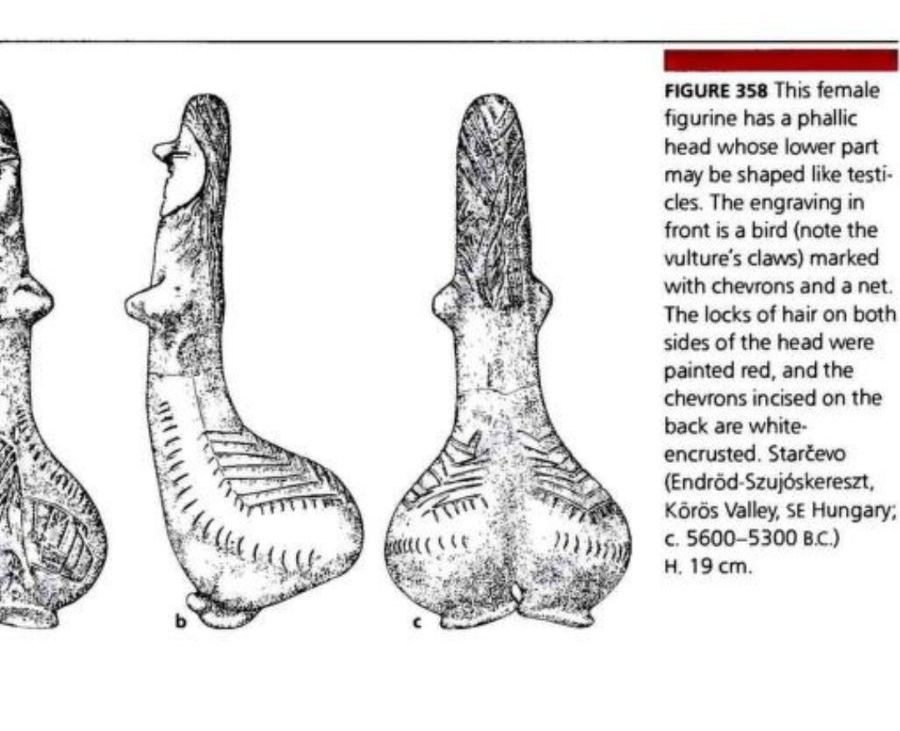
There are also all the Cucuteni statuets which might be familiar to people, the “Neolithic Venuses” which are depicted with no head. Marija Gimbutas states that the main Goddess was the Bird Goddess and on inspection we can see that the “neck” is rounded and the shoulders are pointed like a begining of wings, which she claims are the way people back then abstracted the wings. Therefore those “Venuses” are bird busts on top of female vulva and legs. Because of the rounded neck, I would dare venture the perspective that the head isn’t missing, it’s just not the head we are expecting, if you know what I mean 😉, uniting all elements of creation in the totem.
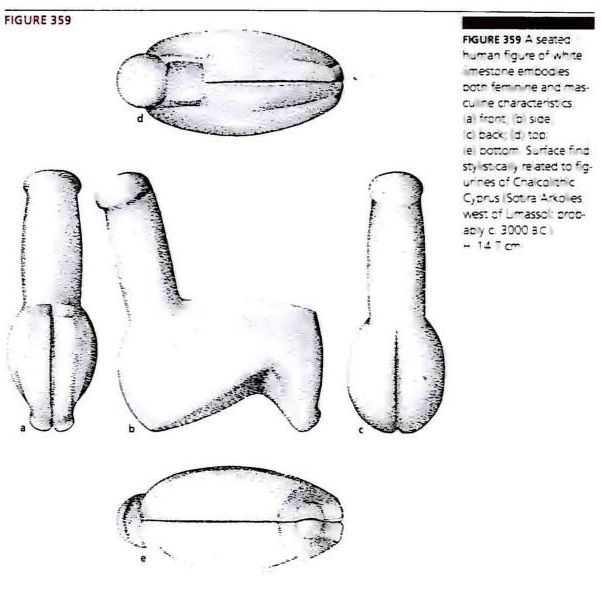
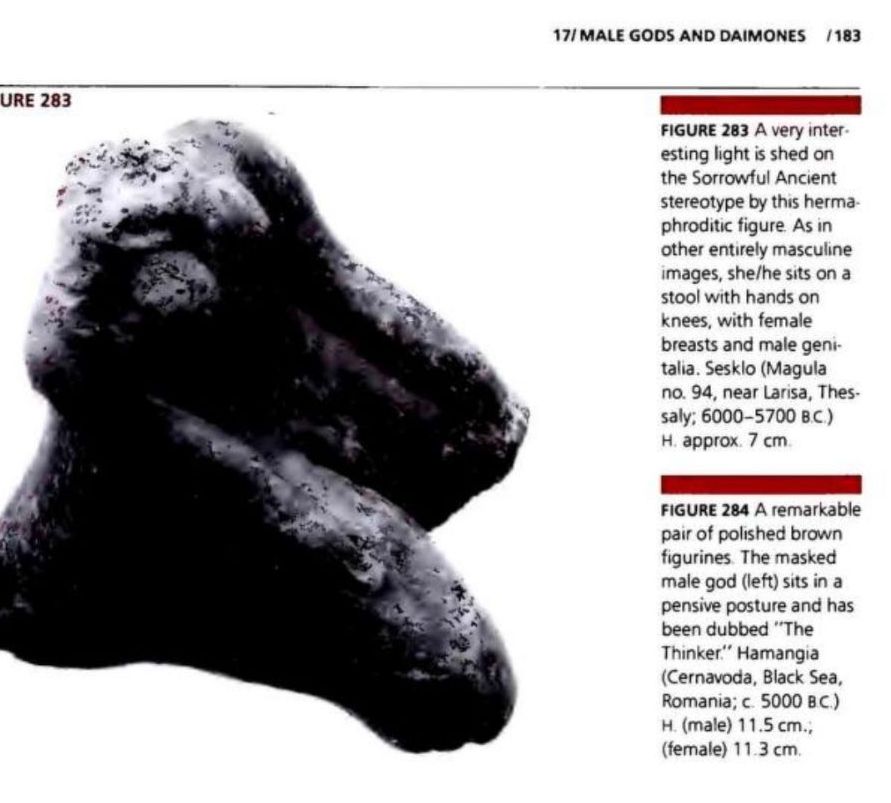
Furthermore, intersex people are depicted in Neolithic art. Gimbutas portrays this statues as a depiction of the male God, but I actually think this statuet is that of an intersex person, with breast and a penis.
Neolithic people were dressed and they even had vertical looms since 7000 BCE. Some statues also depict women in (short) pants. However, they were for sure less pudic than us and were familiar and observant of their bodies. They were surely less judgmental than us, treating all manifestations as natural, which they are.
If something is permited by the laws of nature, it is natural. Otherwise, there is no physical manifestation of that. We can imagine it though, but we cannot bring it into the material world. So we can imagine something unatural, but what we call unatural to justify our discriminatory views are very much natural.
In conclusion, Marija Gimbutas says :
The Goddess in all her manifestations was a symbol of the unity of all life in Nature.
Yoga, anyone?
Gimbutas also underlines that the neolithic Goddesses were not just mother figures, and also that :
There is no trace of a father figure in any of the Paleolithic periods.
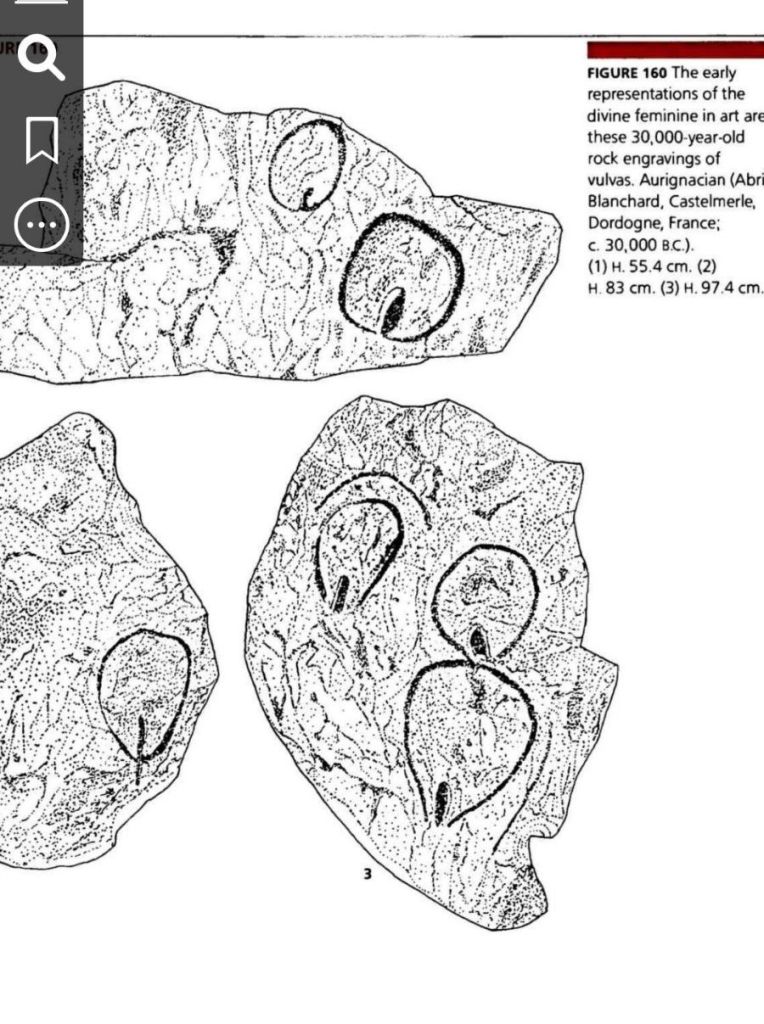
Gimbutas states repeatedly that the Neolithic Goddess created without insemitation for a male counterpart, but as you can tell, I do not agree with that. I do however agree that the medium of creation was more important than the seed, hence more depictions of vulvas. She could be right until one point in history though as the earlies depictions are of vulvas only.
I will end this article with a quote from the conclusion as I really hope to see it fullfiled :
The Goddess gradually retreated into the depths of forests or onto mountaintops, where she remains to this day in beliefs and fairy stories. Human alienation from the vital roots of earthly life ensued, the results of which are clear in our contemporary society. But the cycles never stop turning, and now we find the Goddess reemerging from the forests and mountains, bringing us hope for the future, returning us to our most ancient human roots.
*I find it very much not a coincidence that the begining of yoga, the start of the Kali Era (the most destructive era of the cycle of existance) according Hinduism, and the appearence and spread of patriarchal societies all date from 5000 years ago.


 The joy of creating
2 Comments